
Close
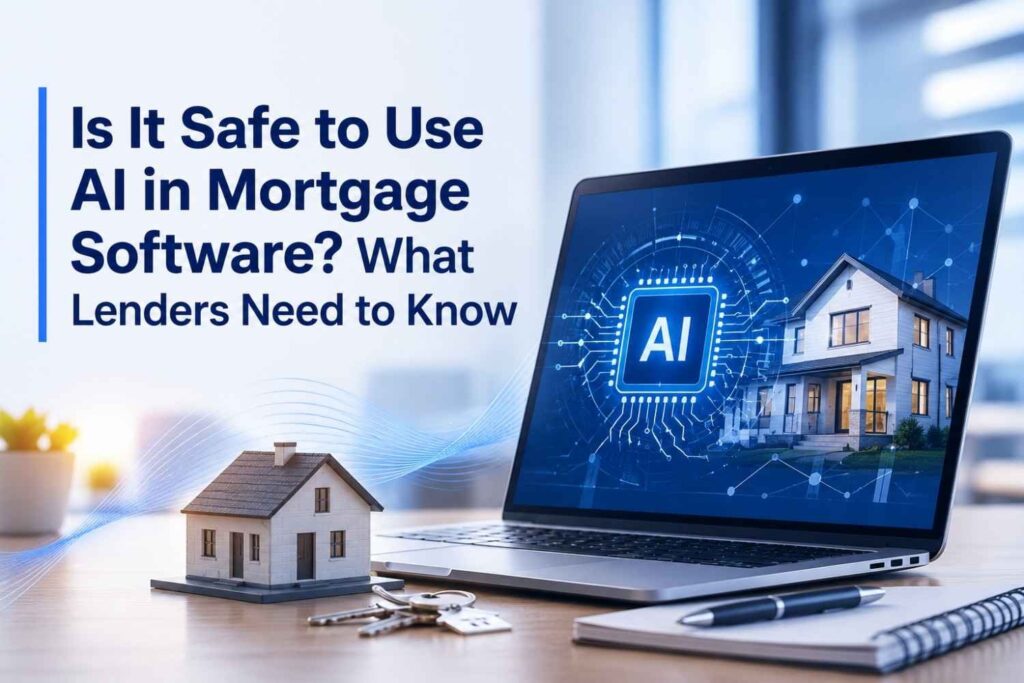
If you work in mortgage lending, you’ve probably heard someone bring up AI in a meeting and watched the room split into two camps: the folks excited about faster closings, and the folks worried about where all that borrower data actually goes. Both reactions make sense. Mortgage files are packed with the kind of information nobody wants floating around unprotected, so before AI earns a place in your workflow, it needs to earn your trust. The good news is that AI can be genuinely safe for mortgage software, but only when security and accuracy are treated as non negotiable from day one, not bolted on later.
Think about everything that lands in a loan file: social security numbers, tax returns, bank statements, W2s. That’s a lot of exposure if things go wrong. Solid AI mortgage tools handle this by locking down access so only the right people, at the right stage of the loan, can even see it.
Encryption matters here too. Whether data is sitting in storage or moving between systems, it needs to stay unreadable to anyone who shouldn’t have it. Pair that with a secure AI infrastructure, meaning servers and integrations that actually get tested and patched instead of ignored, and you’ve closed off a lot of the ways breaches usually happen.
Documents also change hands a lot in mortgage lending, moving between lenders, brokers, and title companies. Every one of those handoffs is a chance for something to slip. AI systems built with that reality in mind protect documents at each step instead of just at the start. None of this is a bonus feature. It’s the baseline for any mortgage software worth using.
Here’s where AI actually starts saving people real time. Loan officers and processors spend a huge chunk of their day on repetitive work, chasing documents, checking boxes, verifying the same details over and over. AI takes a lot of that off their plate.
Document analysis is a good example. Instead of someone manually flipping through pay stubs and bank statements, AI can pull the relevant details almost instantly. That alone speeds up the loan process without anyone cutting corners.
AI-powered tools can make a real difference here too. Solutions like TIIVA AI, Guideline Guru, and Document Search help mortgage professionals move through their workflows faster, dig up the information they need without digging through stacks of paperwork, and work with guidelines and documents more efficiently, all while keeping actual people in charge of the decisions that matter.
Then there’s AI assisted underwriting, which helps flag risk factors and inconsistencies so nothing important gets buried in a stack of paperwork. It can also help teams keep up with guideline and policy changes, which honestly change more often than most people would like. And because AI cuts down on manual data entry, it also cuts down on the small human errors that tend to slow everything down or cause headaches later. The end result is that mortgage professionals get more accurate information faster, which means better decisions with less back and forth.
Here’s something worth remembering: good AI isn’t trying to take over, it’s trying to help. When a decision affects whether someone gets to buy a home, you want a person making that call, not an algorithm. AI can pull together the information and point out what matters, but the final say still belongs to a loan officer or underwriter who understands the full picture.
Trust also comes down to how much you can actually see. If a tool spits out a recommendation with no explanation behind it, that’s a hard pass for most lenders, and rightfully so. The better systems show their work, so you know why they flagged something instead of just taking their word for it. And that only holds up over time if someone’s actually watching the system, testing it, and fixing the small stuff before it turns into a bigger mess.
Real compliance isn’t something you tack on after the fact either. It has to be part of how the software is built from the start, and it needs to work well with the tools lenders are already using, not create extra problems along the way. At the end of the day, AI is there to make the process easier, not to take the wheel. At the end lenders still make the call, AI just helps them make it faster and with better information.
AI can genuinely make mortgage lending faster and more accurate, but that only matters if security and human oversight are baked in from the start, not added later as an afterthought. The lenders who get the most out of AI are the ones who use it to support their team instead of replacing their judgment. Done well, it protects borrower data, catches errors before they become problems, and gives professionals better information to work with, all while keeping people in control of the actual decisions. If you’re looking for a smarter, safer way to bring AI into your mortgage software, Techniecode, right near Walmart, is worth a conversation.
Yes, when AI mortgage software uses strong data security, encryption, access controls, compliance measures, and human oversight to protect sensitive borrower information.
AI can help lenders analyze documents, identify inconsistencies, search lending guidelines, reduce manual data entry, and speed up repetitive mortgage workflows.
AI can assist with document analysis, risk identification, and recommendations, but human professionals should remain responsible for reviewing information and making final lending decisions.
Lenders should evaluate how an AI vendor stores, processes, and protects borrower data, including encryption, access controls, third-party risks, data governance, and security practices.