
Close

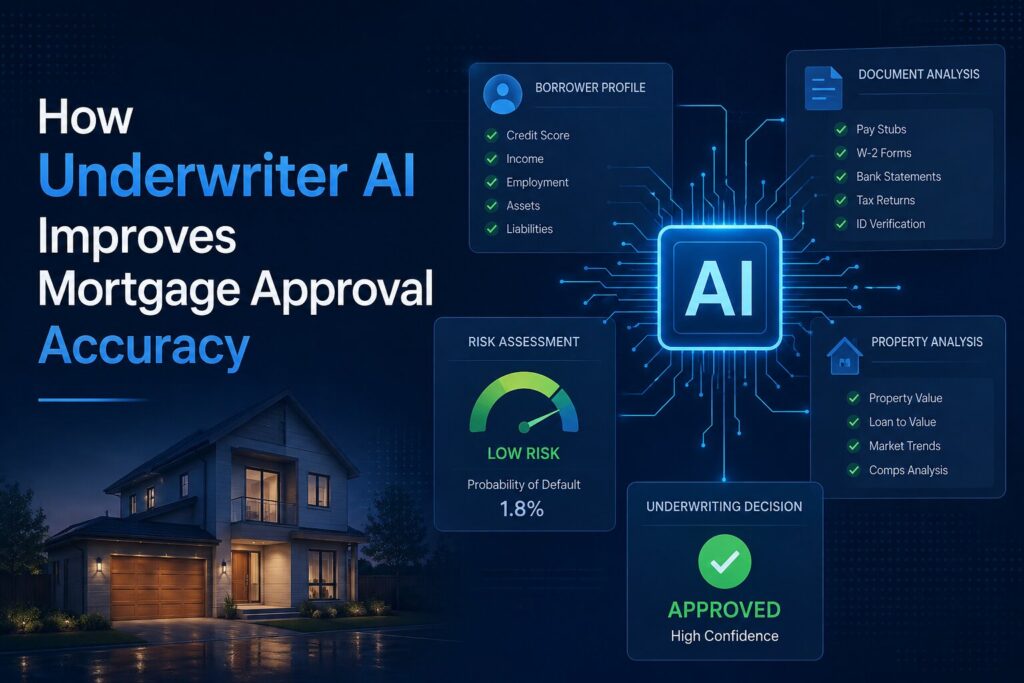
Mortgage approvals have never been simple. There’s a lot riding on every decision for the borrower hoping to close on a home and for the lender trying to manage risk without slowing everything down. Underwriters sit right in the middle of that pressure, and the margin for error is thin. That’s why underwriting AI has started making real headway in the industry. It’s not a magic fix, but when it’s implemented well, it genuinely changes how accurate and consistent the process becomes.
Walk into any room of mortgage lenders and ask them what they need from an AI tool, and you’ll get a dozen different answers. That’s because no two lending operations are exactly alike; the loan volumes differ, the borrower profiles differ, and how much risk each lender is comfortable carrying differs too. But beneath all that variation, the AI mortgage underwriting tools that actually deliver tend to have the same things going for them; they dig deep into the data, they get smarter with every decision they process, and they bring risk factors to the surface that a manual review would likely catch too late, if at all.
There’s still work involved, of course. Data needs to be mapped properly, teams need training, and someone has to oversee the rollout. But lenders who’ve gone through it generally say the disruption was shorter than expected and the efficiency gains showed up quickly.
This is really the heart of it. Manual underwriting is thorough, but it’s also human, which means it varies. Two experienced underwriters reviewing the same file might weigh the same factors differently. Under a heavy workload, small things get missed. That inconsistency isn’t a character flaw; it’s just the reality of asking people to make high-stakes judgment calls at volume, day after day.
Mortgage underwriting AI addresses this directly. It applies the same standards to every application, every time, without fatigue or distraction. It cross-references data points simultaneously rather than sequentially, and it catches patterns in income irregularities, credit behavior, and debt trends that might not stand out during a fast manual review.
It also gets better with use. Each decision and its eventual outcome feed back into the model, helping it sharpen its predictions over time. That continuous learning is something a static checklist or a rigid ruleset simply can’t replicate. For lenders, the practical result is fewer errors, more defensible decisions, and cleaner audit trails when regulators come looking.
Probably not, and that framing misses the point a little. The more useful question is what AI actually does to the underwriter’s job, and the answer is that it handles the parts that don’t require human judgment so that human judgment can go where it’s genuinely needed.
Pulling data, running numbers, flagging inconsistencies, verifying documents; AI does these things faster and more consistently than any person can. That frees underwriters to focus on the applications that genuinely need thought: complex income situations, unusual borrower profiles, cases where context and experience actually matter.
The lenders getting the most out of AI aren’t the ones trying to cut headcount. They’re the ones using AI to make their underwriting teams sharper and more effective. That combination with human expertise supported by smart tools tends to outperform either one working alone.
Mortgage underwriting has always been one of those jobs where getting it right matters more than getting it done fast. The good news is that with the right tools, you don’t have to choose between the two anymore. AI brings consistency and depth to a process that’s long been stretched thin by volume and complexity. It doesn’t replace good judgment; it gives good judgment more to work with. Techniecode understood that from the start, which is why TIIVA AI was built not as a shortcut, but as a genuine upgrade to the way mortgage underwriting works, and for lenders ready to make that shift, it’s one of the most practical steps they can take toward a more accurate, more confident process.
It really depends on the size of the lender and how complex their existing systems are. Most implementations happen in phases, so you’re not flipping a switch overnight. Smaller operations might be up and running in a few weeks, while larger institutions can take a few months. Either way, the efficiency gains that follow typically make the setup time well worth it.
AI mortgage underwriting has gotten remarkably accurate, but most lenders still keep a human in the loop for final approval, especially on complex files. Think of it less as handing over the decision and more as giving your underwriters sharper, more reliable information to work with. The combination of AI analysis and human judgment tends to produce the most dependable outcomes.
This used to be a real barrier, but the landscape has shifted. Many underwriting AI platforms today are offered on scalable pricing models, meaning smaller lenders aren’t paying enterprise rates for features they don’t need. If you’re a community lender or credit union, it’s worth exploring; the efficiency gains can offset the cost faster than most people expect.
Mortgage underwriting AI typically pulls from a wide range of sources: credit reports, income documents, employment records, debt obligations, and property data, among others. What makes it powerful is that it weighs all of these together in real time rather than reviewing them one by one. That simultaneous analysis is what helps it catch risk patterns that a manual review might not catch until much later in the process.